
Kitchen Countertops / Buyer's Guide
Quartz vs Granite Countertops for South Florida Kitchens
Costs, maintenance, heat, stains and sunlight compared, so you can pick the right countertop for how your kitchen is actually used.
Quartz and granite can both produce durable, attractive countertops for a South Florida kitchen. The better choice depends on where the countertop will be installed, how the kitchen is used, how much maintenance the homeowner accepts and whether a consistent or naturally varied appearance is preferred.
For most indoor kitchens, quartz is the more convenient option because it is nonabsorbent, does not require sealing and offers predictable colors and patterns. Granite is often the better fit for homeowners who want authentic natural stone, distinctive slab movement and greater tolerance for heat and sunlight.
South Florida humidity alone should not decide the comparison. The more meaningful factors are spills, direct sunlight, cooking habits, maintenance expectations, slab selection and the quality of fabrication and installation.
The quick answer
Choose quartz when you want
- No routine sealing
- Consistent colors and veining
- Strong resistance to common kitchen stains
- A simple cleaning routine
- Easier matching across multiple slabs
- A contemporary or controlled design
Choose granite when you want
- Authentic natural stone
- A one-of-a-kind slab
- Strong heat tolerance
- Better suitability for sun-exposed applications
- Natural depth and mineral variation
- A traditional, organic or statement appearance
For an indoor, air-conditioned South Florida kitchen, either can perform well. For an outdoor kitchen or a countertop receiving prolonged direct sun, granite or a surface specifically approved for outdoor use deserves stronger consideration.
Quartz vs granite at a glance
| Decision factor | Quartz | Granite |
|---|---|---|
| Material | Engineered surface containing natural quartz, pigments and binders | Natural stone cut and polished into slabs |
| Appearance | Controlled colors and relatively consistent patterns | Natural movement; every slab is different |
| Porosity | Nonabsorbent | Low absorption, but varies by stone |
| Sealing | Normally not required | Depends on the selected granite |
| Heat | Heat resistant, but trivets are necessary | More heat tolerant, though trivets remain advisable |
| Staining | Highly stain resistant | Strong stain resistance when an appropriate stone is maintained correctly |
| Scratching | Highly scratch resistant, but not scratch-proof | Excellent scratch resistance, depending on mineral composition |
| Direct sunlight | Product-dependent; standard interior quartz may discolor | Generally more suitable for sun exposure |
| Outdoor use | Only products specifically approved for exterior use | Commonly used outdoors when properly selected |
| Pattern consistency | Easier to coordinate across several slabs | Variation must be planned carefully |
| Repairs | Some chips can be repaired; heat damage is difficult | Some chips and small defects can be professionally repaired |
| Cleaning | Mild soap, water and a soft cloth | Stone-safe cleaner or mild soap and water |
| Best fit | Low-maintenance indoor kitchens | Natural-stone kitchens and appropriate outdoor applications |
What is quartz?
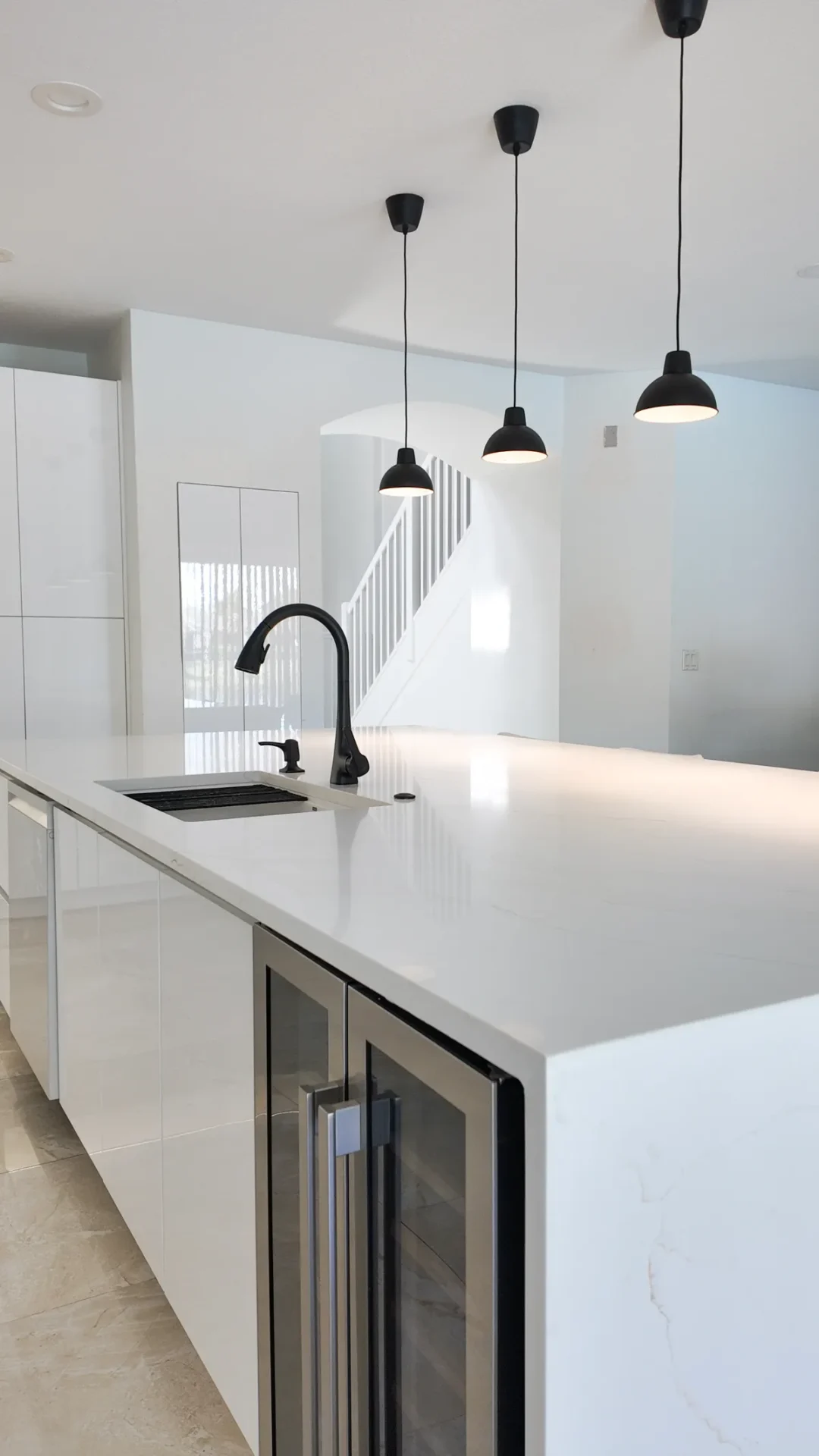
Quartz countertops are engineered surfaces made by combining natural quartz minerals with pigments and binding materials. Their exact composition varies between manufacturers and product lines.
The manufacturing process allows quartz producers to create controlled colors, patterns and veining. Designs can resemble marble, concrete, granite or other materials while maintaining more consistency than natural stone.
Quartz is nonabsorbent, so it does not normally require sealing. Manufacturer care instructions commonly recommend mild soap, warm water and a soft cloth for routine cleaning.
Cambria, for example, states that its quartz surfaces do not require sealing, polishing or reconditioning. It also warns that quartz is not heat-proof and recommends using a solid trivet beneath hot cookware and heat-producing appliances. Homeowners should always follow the instructions for the specific product they purchase.
What is granite?
Granite is a natural stone extracted from quarries and cut into slabs. Its colors and patterns are created by the stone's mineral composition rather than a manufacturing process.
Each granite slab is different. Even two slabs from the same block can contain changes in movement, mineral deposits, shade and pattern.
Granite is known for its durability, longevity and heat resistance. The Natural Stone Institute reports that granite typically has a very low water-absorption range and is suitable for heavily used surfaces such as kitchen countertops.
One important point often missed in online comparisons is that not every granite countertop requires annual sealing. The need for sealing depends on the particular stone and how it was processed. The Natural Stone Institute states that many granite countertops may not require sealing, while some receive additional stain resistance from an appropriate penetrating treatment. This is more accurate than applying one universal sealing schedule to every granite slab.
Does Florida humidity make quartz better than granite?
Many comparison articles claim that Florida humidity automatically makes quartz the winner. That conclusion is too broad.
Quartz is nonabsorbent, which makes it easy to maintain around spills. However, a granite countertop inside an air-conditioned kitchen is not continually absorbing large amounts of moisture from the air simply because the home is in Florida.
Granite absorption rates are generally low and vary by stone. The more practical concerns are:
- Whether the selected granite benefits from sealing
- How quickly oil, wine, coffee or citrus spills are cleaned
- Whether plumbing leaks are corrected
- Whether the surface is installed indoors or outdoors
- How much direct sunlight reaches the countertop
- Whether the homeowner follows the fabricator's care instructions
Quartz still has a maintenance advantage because it does not normally require sealing. But properly selected and maintained granite can also perform well in Miami-Dade, Broward and Palm Beach County kitchens.
Humidity should be considered, but it should not be used as a shortcut that replaces evaluation of the actual product.
Which countertop resists stains better?
Quartz generally wins for stain resistance because its surface is nonabsorbent. Coffee, wine, cooking oil and sauces have less opportunity to penetrate the material. Spills should still be cleaned promptly. A surface can be stain resistant without being immune to discoloration, residue or chemical damage.
Granite can also resist stains effectively. Its performance depends on the stone's absorption characteristics, any factory treatment, the condition of the surface and whether a suitable sealer was recommended. Light-colored or more absorbent natural stones may require greater attention than dense granite varieties.
Before purchasing granite, ask the fabricator:
- What is the stone's absorption level?
- Was the slab resin-treated at the factory?
- Does this particular granite benefit from sealing?
- Which sealer is recommended?
- How will the homeowner know when another treatment is needed?
- Which cleaning products should be avoided?
This product-specific approach is more trustworthy than automatically instructing every granite owner to reseal once a year.
Which material handles heat better?
Granite has the advantage in heat tolerance. The Natural Stone Institute identifies granite as heat resistant, though it still discourages concentrated direct heat because rapid temperature differences can contribute to cracking.
Quartz contains binding materials that can be damaged by direct or sustained heat. A pan, electric griddle, air fryer, slow cooker or other heat-producing appliance can discolor or damage the surface. Use a solid trivet or heat-resistant pad on both materials.
Quartz owners should be especially careful around:
- Ovens and cooktops
- Air fryers and toaster ovens
- Electric skillets and countertop grills
- Slow cookers and pressure cookers
- Heat lamps
If someone in the household frequently places hot cookware directly on the counter, granite may be the more forgiving option. Changing that habit and using trivets can make quartz equally practical for daily cooking.
Which countertop is more scratch resistant?
Both materials resist normal kitchen scratches, but neither is scratch-proof. Quartz provides relatively consistent performance because it is manufactured. Granite's hardness can vary according to its mineral composition.
Homeowners should use a cutting board on either surface. Cutting directly on a countertop can damage knives, leave metal markings, affect the surface finish, increase the chance of accidental chipping and create unnecessary cleaning problems. Edges around sinks and dishwashers are especially vulnerable to impact, and heavy cookware should not be dropped against countertop edges regardless of the material.
Quartz vs granite in direct South Florida sunlight
Direct sunlight is a more important South Florida consideration than many indoor-humidity claims. Standard quartz products can discolor when exposed to prolonged ultraviolet light. The degree of risk depends on the product, color, location and manufacturer.
This matters in kitchens with large unshaded windows, skylights, glass walls, indoor-outdoor openings, sunrooms, covered terraces or outdoor cooking areas.
Granite generally handles sunlight better because its color is created by natural minerals rather than resin and pigment systems. However, homeowners should not assume that every quartz product is restricted to indoor use. Some manufacturers now offer quartz surfaces specifically designed and warranted for exterior applications.
Do not use a standard interior quartz countertop outdoors unless the manufacturer explicitly approves and warrants that product for exterior exposure. Review the warranty before purchase. Product-specific approval matters more than a general statement about quartz as a category.
Quartz vs granite for outdoor kitchens
Granite is commonly selected for South Florida outdoor kitchens because of its natural appearance, heat tolerance and ability to handle sun exposure when the correct stone and finish are used. Outdoor-rated porcelain and specially manufactured exterior surfaces may also be suitable.
Quartz should only be considered when:
- The exact product is rated for outdoor installation
- The manufacturer provides an exterior warranty
- The installation follows manufacturer requirements
- The color and finish are approved for UV exposure
- Heat-producing appliances have proper clearances
Outdoor-kitchen planning should treat the countertop as part of a larger system that includes cabinetry, appliances, shade, drainage, utilities and wind exposure. An indoor countertop decision should not automatically be copied into an outdoor kitchen.
Maintenance: what ownership actually looks like
Quartz maintenance
- Wipe spills promptly
- Clean with warm water and mild soap
- Use a soft cloth
- Protect the surface from direct heat
- Avoid abrasive scrubbers
- Avoid strong solvents, acids and alkaline cleaners
- Follow the manufacturer's instructions
- Register the product warranty when required
Quartz should not be sealed unless the manufacturer specifically instructs otherwise.
Granite maintenance
- Clean spills promptly
- Use mild soap or a stone-safe cleaner
- Avoid acidic and abrasive cleaners
- Use trivets beneath hot cookware
- Follow recommendations for the selected stone
- Test or evaluate stain resistance when advised
- Apply a penetrating treatment only when needed
Sealing does not make granite completely stain-proof. It provides additional time to clean a spill before it penetrates.
Appearance: controlled design or natural character?
The aesthetic difference is one of the most meaningful factors.
Quartz appearance
Quartz suits homeowners who want predictable colors, controlled veining, consistency across a large island, easier matching between slabs, marble-inspired designs, contemporary solid colors and coordinated full-height backsplashes. It can simplify the design process when cabinetry, flooring and backsplash materials have already been selected.
Granite appearance
Granite suits homeowners who want unique natural movement, mineral depth, one-of-a-kind colors, organic variation, a statement slab and natural character that cannot be duplicated. The actual granite slab should be viewed before fabrication. A small sample cannot show all the veins, fissures, mineral deposits and color changes that may appear across a full slab.
Seams and pattern matching
Neither quartz nor granite is automatically seamless. Seam visibility depends on slab dimensions, countertop layout, pattern direction, cabinet placement, sink and cooktop locations, fabricator experience, seam color, edge profile and installation access.
Quartz may be easier to coordinate because its pattern is generally more predictable, though large-vein quartz still requires thoughtful placement so the design does not appear interrupted at seams. Granite requires the fabricator and homeowner to plan around natural movement; bookmatching and careful slab positioning can create a dramatic result, but they may require additional material. Ask to review the seam map before fabrication begins.
Quartz vs granite cost in South Florida
Quartz and granite prices overlap significantly. Neither material is always cheaper. Published Florida price guides vary widely, with installed prices moving from entry-level selections to premium slabs well above $100 per square foot. This range is too broad to serve as an actual project quote.
Pricing is affected by:
- Slab brand or stone classification, thickness and number of slabs
- Total square footage, pattern and color availability
- Fabrication difficulty, edge profile, sink and cooktop cutouts, faucet holes
- Waterfall panels, full-height backsplash and seam quantity
- Existing-countertop removal, cabinet leveling and reinforcement
- Condo delivery restrictions and installation access
- Plumbing disconnection and reconnection
A rare granite can cost more than many quartz designs, and premium designer quartz can cost more than standard granite. The best comparison is a complete installed proposal for the actual kitchen, not an online material price.
Hidden cost issues competitors often miss
- Slab yield. A kitchen may need a second slab because of one island dimension, a large pattern or the required seam placement, so you may pay for more material than the final square footage suggests.
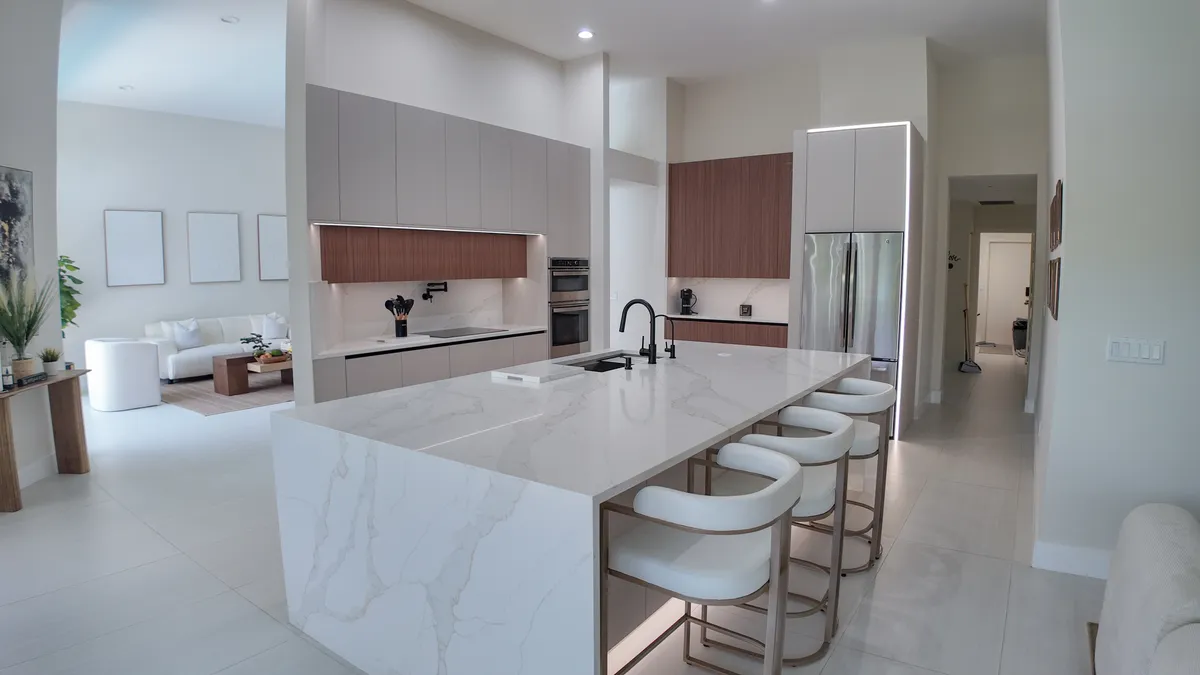
- Waterfall panels. A waterfall island adds material, fabrication and pattern-matching work, and vein alignment can affect the number of slabs required.
- Cabinet preparation. Countertops require cabinets that are structurally sound, straight, level and properly secured. Repairs or modifications can add to the scope.
- Sink support. Large workstation, cast-iron and apron-front sinks may require additional cabinet planning and support.
- Condo access. Freight elevators, loading schedules, slab dimensions and building rules can affect delivery and installation.
- Plumbing work. Sink, faucet, disposal, filtration and dishwasher connections may need professional disconnection and reconnection.
- Backsplash decisions. A full-height slab backsplash can change material quantities and seam planning substantially.
Which material is better for a Miami condo?
Quartz is often practical for a Miami condo because it offers consistent appearance, minimal routine maintenance, easy coordination with modern cabinetry, predictable design across an island and perimeter, and a broad range of light colors. Granite can be equally appropriate when the homeowner wants natural stone and the slab can be delivered safely.
Condo-specific considerations include freight-elevator dimensions, loading-dock reservations, contractor insurance requirements, building work hours, common-area protection, noise restrictions, slab maneuverability, plumbing shutoff coordination and debris-removal procedures. A design should never be finalized before confirming that the selected slab can physically reach the kitchen.
Which material is better for a rental or seasonal home?
Quartz may be more convenient in a rental or seasonal property because it does not normally require sealing and its care instructions are easier to communicate. However, guests and tenants still need to protect quartz from heat.
Granite may work well when the stone has low absorption, the countertop condition is periodically checked, the household follows appropriate care instructions, and the owner prefers the longevity and natural appearance of stone. The best rental surface is one that matches the property's level of use, management and expected maintenance.
Which material is better for resale?
Both quartz and granite can support buyer appeal. The overall kitchen usually matters more than choosing one of these two premium materials. Resale value is influenced by cabinet condition, layout, storage, countertop condition, installation quality, color choices, appliances, lighting, flooring and neighborhood expectations.
Quartz may appeal to buyers who prioritize low maintenance and contemporary design. Granite may appeal to buyers who value authentic natural stone. Neutral does not have to mean plain; the safest resale choice is usually a countertop that complements the cabinetry and architecture without overpowering the room.
South Florida decision guide
| Your priority | Better starting choice | Why |
|---|---|---|
| Lowest routine maintenance | Quartz | Does not normally require sealing |
| Strongest natural variation | Granite | Each slab is unique |
| Frequent high-heat cooking | Granite | Greater heat tolerance |
| Controlled marble-look design | Quartz | Predictable manufactured patterns |
| Outdoor kitchen | Granite or exterior-rated product | Better starting point for UV and heat exposure |
| Large matching island and perimeter | Quartz | Easier pattern coordination |
| One-of-a-kind statement island | Granite | Natural movement creates individuality |
| Seasonal residence | Quartz | Simpler maintenance |
| Strong direct sunlight | Granite or approved exterior surface | Standard quartz may discolor |
| Natural-material preference | Granite | Quarried natural stone |
| No interest in sealing | Quartz | Nonabsorbent surface |
| Luxury slab selection experience | Either | Depends on design and product |
A five-step selection process
Define how the kitchen is used
Discuss cooking habits, entertaining, children, rental use, direct sunlight and maintenance expectations.
Review full slabs
Do not choose from a small sample alone. Examine full quartz patterns and actual granite slabs.
Compare complete installed prices
Include fabrication, cutouts, seams, edge profiles, delivery, installation, plumbing and cabinet preparation.
Review care and warranty documents
Confirm heat precautions, cleaning instructions, UV restrictions, sealing recommendations and warranty-registration requirements.
Approve the fabrication plan
Review seams, vein direction, sink placement, faucet holes, overhangs, waterfall panels and backsplash transitions before the slab is cut.
Countertop installation checklist
Before fabrication
- Confirm the final cabinet layout
- Confirm appliance model numbers
- Confirm sink and faucet specifications
- Verify cabinet strength and level
- Select the edge profile and approve overhangs
- Determine support requirements
- Confirm backsplash material
- Review slab quantity and approve seam locations
- Approve vein direction
- Confirm condo delivery access
- Review manufacturer care instructions and warranty
- Obtain a written scope and installation schedule
After installation
- Inspect seams and edges
- Confirm the countertop is supported
- Check sink attachment and support
- Inspect faucet holes
- Test plumbing connections
- Review cleaning instructions
- Register applicable warranties
- Keep the slab and product information for future repairs
Common quartz and granite myths
Myth: all granite must be sealed every year
Not necessarily. Some granite benefits from sealing, while other granite may not require frequent treatment. Follow guidance for the specific stone rather than a universal calendar.
Myth: quartz cannot be used outdoors
Standard interior quartz should not be placed outdoors without manufacturer approval. However, some manufacturers offer products specifically engineered and warranted for outdoor use.
Myth: granite is completely heat-proof
Granite has strong heat tolerance, but concentrated or sudden thermal changes can still create risk. Trivets are recommended.
Myth: quartz is stain-proof
Quartz is highly stain resistant, not immune to all discoloration or chemical damage. Spills should still be cleaned promptly.
Myth: quartz always costs more than granite
Prices overlap. The selected slab, fabrication and installation details determine the final cost.
Myth: South Florida humidity ruins granite
Properly selected granite can perform well in South Florida. Spills, care, stone absorption and installation conditions are more useful considerations than humidity alone.
Final verdict
Quartz is the better choice for many indoor South Florida kitchens when homeowners prioritize low maintenance, predictable design and strong resistance to everyday spills. Granite is the better choice when homeowners prioritize natural variation, heat tolerance, direct-sun performance or an appropriate outdoor application.
There is no universal winner. The correct decision should be made after reviewing the actual slab, manufacturer instructions, kitchen layout, sunlight, cooking habits and complete installed price.
Frequently asked questions
Is quartz or granite better for a Florida kitchen?
Quartz is often more convenient for an indoor Florida kitchen because it does not normally require sealing. Granite may be better for homeowners who prefer natural stone, cook frequently with high heat or have strong sunlight entering the kitchen.
Does Florida humidity damage granite countertops?
Normal indoor humidity does not automatically damage granite. Granite has low absorption, and many varieties perform well in Florida. Follow the fabricator's care recommendations for the selected stone.
Does every granite countertop need annual sealing?
No. Sealing requirements vary. The Natural Stone Institute states that many granite countertops may not require sealing, although some benefit from an appropriate treatment.
Can quartz countertops be installed in direct sunlight?
Prolonged ultraviolet exposure can affect some standard quartz products. Review the manufacturer's warranty and select a surface specifically approved for the intended exposure.
Can quartz be used in an outdoor kitchen?
Only use quartz outdoors when the exact product is approved and warranted for exterior installation. Granite, porcelain and other outdoor-rated surfaces may be safer starting options.
Can you place a hot pan on granite?
Granite tolerates heat better than quartz, but trivets are still recommended because concentrated temperature changes can create damage.
Does quartz need to be sealed?
Quartz does not normally require sealing. Follow the care instructions provided by the surface manufacturer.
Which countertop is easier to repair?
Repairability depends on the damage, color and pattern. Some granite chips can be filled and polished. Some quartz chips can also be repaired, but heat discoloration can be difficult to correct invisibly.
Which material is better for a waterfall island?
Both can work. Quartz often provides more predictable pattern coordination, while granite can create a dramatic natural statement. Slab yield and vein alignment should be reviewed before fabrication.
Should I choose the countertop before the cabinets?
The materials should be coordinated during design, but final countertop measurements should be completed after the cabinets are installed, secured and checked for level.
Plan your South Florida kitchen countertops
MIA Remodeling Contractors provides kitchen design, custom cabinetry and countertop fabrication for homes, condos and commercial properties across South Florida. Our team coordinates the countertop with the cabinetry, sink, plumbing, appliances, backsplash and lighting while helping you review full slabs, fabrication details and material-care requirements.
Florida general-contractor license CGC1535875. Serving Miami-Dade, Broward and Palm Beach counties.