
Kitchen Countertops / Buyer's Guide
Quartz vs Porcelain Countertops for South Florida Kitchens
Cost, heat, sunlight, scratch resistance, outdoor use and edges compared, so you can choose the right surface for your kitchen.
Choosing between quartz and porcelain countertops requires more than comparing colors and prices. Both materials are durable, nonabsorbent and available in realistic stone-inspired designs, but they perform differently around heat, direct sunlight, heavy impacts and complex countertop edges.
For most indoor South Florida kitchens, quartz provides dependable performance, broad design options and easier fabrication. Porcelain becomes especially attractive for kitchens exposed to strong sunlight, outdoor cooking areas and homeowners who prioritize heat and scratch resistance.
The best choice ultimately depends on where the countertop will be installed, how you use your kitchen and whether your fabricator has experience working with the selected product. If you are also weighing natural stone, see our guide to quartz vs granite countertops.
The quick answer
Choose quartz for an indoor kitchen when you want more design choices, thicker-looking edges and greater resistance to edge impacts. Consider porcelain when heat resistance, direct sunlight, outdoor suitability or an ultra-thin contemporary appearance matters most.
Choose quartz if
- Your countertop will be installed indoors
- You want the widest selection of colors and patterns
- Decorative edge profiles are important
- You prefer an established fabrication process
- You want consistent patterns across several slabs
- Edge-impact resistance is a major concern
- The countertop will not receive prolonged direct sunlight
Choose porcelain if
- The countertop will receive strong sunlight
- You are planning an outdoor kitchen
- Heat resistance is a top priority
- You want a thin, contemporary profile
- You prefer an indoor-outdoor material connection
- Scratch resistance is particularly important
- The exact product is approved for the intended application
Quartz vs porcelain at a glance
| Comparison factor | Quartz | Porcelain |
|---|---|---|
| Composition | Quartz minerals combined with pigments and binders | Refined minerals and clays fired at extremely high temperatures |
| Porosity | Nonabsorbent | Very low absorption |
| Sealing | Normally not required | Normally not required |
| Heat resistance | Moderate; trivets are necessary | Excellent, depending on the product |
| Stain resistance | Excellent | Excellent |
| Scratch resistance | Very good | Excellent |
| Edge-impact resistance | Generally better | Edges may be more vulnerable to chipping |
| Direct sunlight | Product and warranty limitations may apply | Usually more UV resistant |
| Outdoor installation | Usually not recommended | Many products are suitable outdoors |
| Edge options | Broad selection | More limited, especially with thin slabs |
| Fabricator availability | Widely available | Requires specialized experience |
| Maintenance | Simple routine cleaning | Simple routine cleaning |
| Repairability | Difficult, but some chips can be filled | Difficult to repair invisibly |
| Best application | Indoor kitchens and bathrooms | Indoor-outdoor kitchens and sun-exposed spaces |
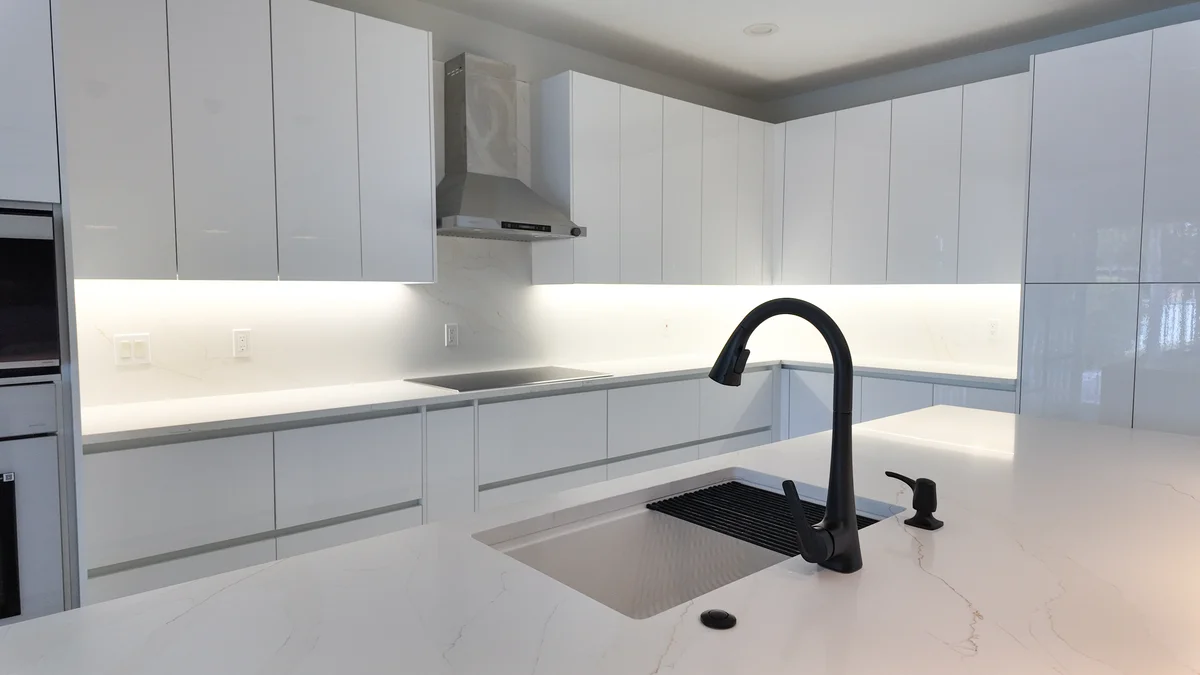
What are quartz countertops?
Quartz countertops are engineered surfaces made by combining quartz minerals with pigments, resins and other binders. The manufacturing process allows brands to produce controlled patterns, consistent colors and slabs designed to resemble marble, granite, concrete or other materials.
Because quartz is nonabsorbent, it normally does not require sealing. Everyday spills are less likely to penetrate the surface, making quartz practical for busy kitchens, rental properties and seasonal South Florida residences.
Quartz is commonly available in two-centimeter and three-centimeter slabs. Its established fabrication methods also make it easier to create decorative edges, large islands, waterfall panels and coordinated countertop-and-backsplash installations.
However, the binders used in quartz can be affected by concentrated heat and prolonged ultraviolet exposure. Hot cookware and heat-producing appliances should never be placed directly on the surface without protection.
What are porcelain countertops?
Porcelain countertops are manufactured from refined clay and mineral-based materials that are compressed and fired at very high temperatures. This creates a dense surface with low water absorption and strong resistance to heat, scratches and stains.
Large-format porcelain slabs can reproduce the appearance of marble, limestone, concrete, metal and other materials through advanced printing and surface-finishing techniques. Many slabs are thinner than traditional quartz countertops, creating a lightweight-looking, contemporary profile.
One important clarification is that porcelain, sintered stone and ultracompact surfaces are not always identical products. Showrooms and online articles sometimes group them together because they offer similar benefits, but their composition, thickness, installation requirements and warranties can still differ.
Always request the technical data sheet for the exact product rather than assuming that every porcelain or ultracompact surface has the same performance characteristics.
Which costs more: quartz or porcelain?
Quartz and porcelain countertop prices frequently overlap. Neither material should automatically be considered the cheaper option.
Current national planning guides place installed quartz around $50 to $150 per square foot and porcelain around $40 to $120 per square foot, but South Florida pricing can vary substantially based on the brand, slab, fabrication difficulty and installer experience. Treat these as planning ranges, not project quotes.
Several factors influence the final installed price:
- Slab brand and collection
- Slab thickness and dimensions
- Kitchen layout, and the number and location of seams
- Waterfall island panels and mitered porcelain edges
- Sink and cooktop cutouts, and backsplash height
- Pattern alignment and required countertop support
- Existing countertop removal, cabinet leveling or reinforcement
- Plumbing disconnection and reconnection
- Condo delivery and elevator restrictions, and fabricator availability
Why porcelain fabrication can cost more
Porcelain slabs can be thinner and lighter than quartz, but that does not necessarily make them easier to install. Large-format porcelain requires specialized cutting equipment, proper handling and an experienced fabrication team. Sink cutouts, inside corners and mitered edges require particular care, and fabrication mistakes may crack or chip the slab, increasing material waste and labor costs. A porcelain proposal from an experienced fabricator may cost more than a basic quartz installation, but fabrication quality is not the right place to choose the lowest bid.
Why quartz costs vary so widely
Quartz pricing changes according to the brand, pattern, slab size and design collection. Simple solid colors may fall near the lower end of the range, while detailed marble-inspired designs and large-format slabs may cost considerably more. An island that requires a second slab can also increase the project cost even when only part of that slab is used.
Quartz vs porcelain durability
Both materials are suitable for heavily used kitchens when correctly fabricated and installed. Their vulnerabilities, however, are different.
Heat resistance
Porcelain has the advantage around high temperatures. Its manufacturing process involves extreme heat, and many porcelain or ultracompact surfaces are specifically promoted for excellent heat resistance. Quartz contains binders that can react to direct or sustained heat; hot pans, electric skillets, air fryers, slow cookers and countertop ovens can create concentrated heat that damages or discolors the surface. Quartz owners should consistently use trivets or insulated pads, and following the manufacturer's care instructions remains the safest approach for either material.
Scratch resistance
Porcelain is extremely hard and generally offers stronger scratch resistance. Quartz also performs well under normal kitchen use but can develop marks when abrasive items are dragged across the surface. A cutting board should still be used with both materials, since cutting directly on the countertop can damage the finish, leave metal marks or quickly dull kitchen knives. Some polished, dark or solid-colored finishes may show surface marks more noticeably than heavily patterned designs.
Edge chipping and heavy impacts
Quartz generally has an advantage when it comes to edge-impact resistance. Its thicker profile and engineered composition can make it more forgiving when an object hits the edge. Porcelain has a very hard surface, but exposed edges and corners can be vulnerable to concentrated impacts; a heavy cast-iron pan striking the edge near a sink or dishwasher may cause a chip that is difficult to repair invisibly. The risk can be reduced through appropriate edge design, careful fabrication and proper support around cutouts.
Stain resistance
Both quartz and porcelain offer excellent resistance to common kitchen spills and normally require no sealing. Coffee, cooking oil, tomato sauce and wine should still be cleaned promptly, because leaving spills on any countertop unnecessarily increases the chance of discoloration, residue or interaction with surface finishes. The appropriate cleaner depends on the manufacturer and finish; mild soap, warm water and a soft cloth are generally safe starting points.
Cracking
Neither material is crack-proof. Quartz may crack because of inadequate cabinet support, excessive overhangs, building movement or thermal stress. Porcelain may crack during transportation, fabrication or installation when it is handled incorrectly. Countertop durability therefore depends on more than the slab; cabinet preparation, support placement, cutout design and installation quality are equally important.
Which material is better for South Florida kitchens?
South Florida's climate does not automatically make one material better for every kitchen. The location and exposure of the countertop are more important than humidity alone.
Direct sunlight
Large windows, sliding doors and open-concept living spaces can expose countertops to hours of strong sunlight. Some quartz products may discolor or change over time when exposed to prolonged ultraviolet light, and sun-related changes may also be excluded from the manufacturer's warranty. Porcelain and many ultracompact surfaces provide stronger UV resistance, making them worth considering for sun-filled kitchens. Cosentino, for example, identifies UV resistance as a benefit of its Dekton ultracompact surfaces, though product approval should still be confirmed for the exact color and finish.
Outdoor kitchens
Standard interior quartz should not be assumed suitable for a South Florida outdoor kitchen. Sun, rain, heat and changing weather conditions can affect the surface and invalidate warranty coverage. Many porcelain and ultracompact products are designed for both indoor and outdoor applications, making them strong candidates for covered patios, poolside kitchens and exterior entertainment areas.
Confirm all of the following before ordering:
- Exterior-use approval and UV resistance
- Heat limitations and required substrate
- Wind and structural considerations
- Edge treatment and adhesive requirements
- Warranty coverage and maintenance instructions
Porcelain may be the better material outdoors, but only when the complete installation system is designed for exterior conditions.
Humidity and moisture
Both materials have very low absorption and normally perform well in humid environments, so indoor South Florida humidity should not be the main factor separating quartz from porcelain. Moisture protection still matters around sinks, faucets, backsplashes and outdoor cabinetry, because water can damage cabinet boxes, wall assemblies and poorly sealed joints even when the countertop itself is nonabsorbent.
Coastal installations
For homes near the ocean, the countertop surface is only one part of the system. Salt air can affect metal brackets, fasteners, outdoor appliances and cabinet hardware, so an exterior countertop installation should include corrosion-resistant support components and materials selected for coastal exposure.
Condo kitchens
Porcelain's thin profile can complement modern Miami condominium interiors, but large slabs remain difficult to transport. Before finalizing the layout, the contractor and fabricator should check freight-elevator dimensions, loading-dock rules, delivery hours, hallway and doorway clearances, stairwell access, slab turning radius, maximum panel dimensions, HOA insurance requirements and permitted construction hours. Access limitations can determine slab size and seam placement before fabrication begins.
Appearance and design options
Quartz and porcelain can both produce sophisticated contemporary kitchens, but they create different design opportunities.
Quartz design advantages
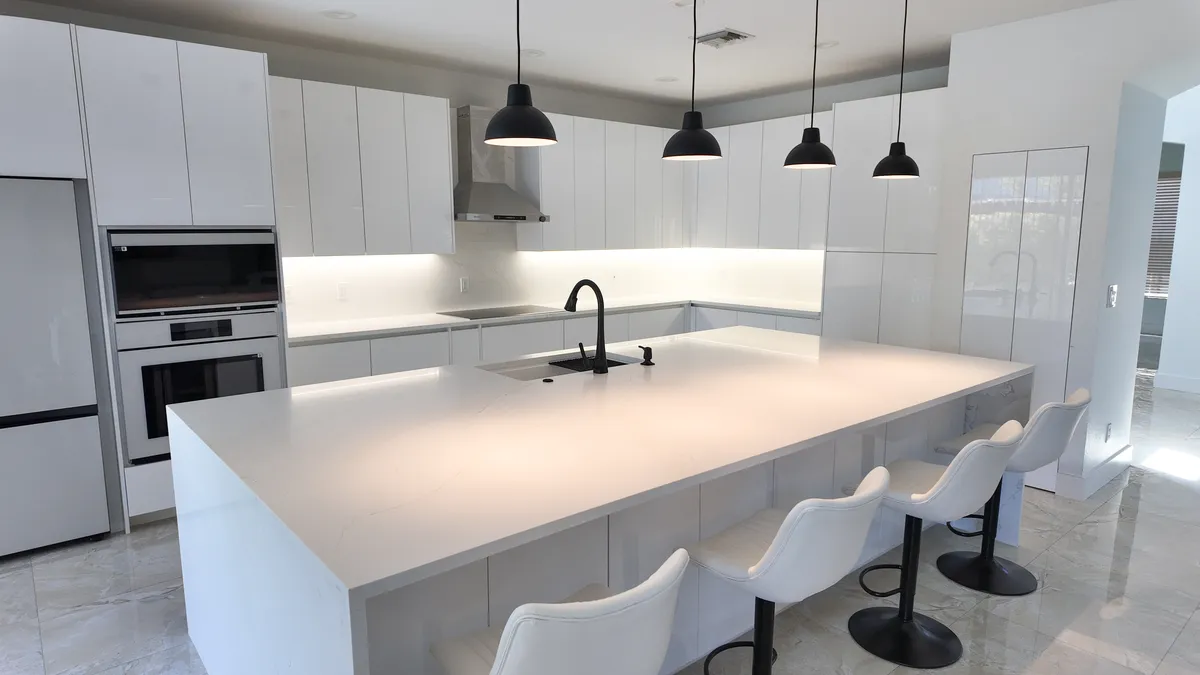
Quartz offers one of the widest countertop selections available. Homeowners can choose from solid colors, subtle patterns, dramatic veining and surfaces inspired by marble or concrete. Its pattern consistency helps when coordinating multiple slabs across a large island, perimeter cabinets and full-height backsplash. Quartz also accommodates a wider range of edge profiles, including eased, beveled, bullnose and ogee profiles, waterfall panels and mitered built-up edges.
Porcelain design advantages
Porcelain works especially well in minimalist and European-inspired kitchens. Thin slabs can create a clean, lightweight appearance, while mitered edges can make the surface appear substantially thicker. The material can also continue vertically across backsplashes, cabinet panels and feature walls. However, many porcelain designs are printed primarily on the surface, so the exposed edge may not display the same veining as the face; a mitered edge can conceal the material body and create a more continuous pattern, but it requires precise fabrication.
Before purchasing porcelain, ask to see:
- The unfinished slab edge and a completed mitered-edge sample
- Pattern depth and book-matching availability
- Finish variations and the recommended seam adhesive
- Installed examples from the fabricator
Maintenance comparison
Quartz and porcelain are both low-maintenance surfaces. Neither normally requires the periodic sealing associated with many natural stones.
How to clean quartz countertops
- Remove loose crumbs and abrasive particles.
- Use warm water and mild soap.
- Wipe with a soft cloth or nonabrasive sponge.
- Dry the surface to reduce streaking.
- Clean spills promptly.
Avoid abrasive pads, oven cleaners and chemicals not approved by the manufacturer. Cambria advises cleaning its quartz using warm water, a soft cloth and mild soap, and states that its surface does not require sealing, polishing or reconditioning.
How to clean porcelain countertops
- Wipe away spills and food residue.
- Clean with warm water and a manufacturer-approved cleaner.
- Use a soft cloth or nonabrasive sponge.
- Follow finish-specific instructions for polished surfaces.
- Avoid striking exposed edges with heavy cookware.
Neolith states that its countertop surfaces do not absorb residue and are resistant to most cleaning agents, while still directing homeowners to product-specific care information.
Does either material need sealing?
Quartz and porcelain normally do not require sealing. The important word is "normally." Confirm whether the countertop includes another material, special finish, joint treatment or adjoining natural-stone element that has separate maintenance requirements.
Fabrication and installation differences
Quartz is familiar to most established countertop shops. Fabrication methods, seam adhesives and edge profiles are widely understood. Porcelain fabrication is more specialized: the material requires suitable blades, cutting speeds, handling systems and installers who understand its edge and cutout limitations.
Before selecting porcelain, ask the fabricator:
- How many porcelain countertop projects have you completed?
- Can I see photographs of completed sink cutouts and mitered edges?
- Which slab brands do you regularly fabricate?
- Who is responsible if a slab breaks during fabrication?
- How will the countertop be supported, and where will seams be located?
- How will the pattern align across the edge?
- What installation warranty is provided?
- Are you approved or trained by the manufacturer?
- Will cutting and polishing occur at the shop rather than inside the home?
Silica-dust safety matters
Cutting, grinding and polishing manufactured and natural countertop materials can release respirable crystalline silica. This is primarily an occupational risk for fabrication and installation workers, which is another reason homeowners should avoid attempting countertop fabrication themselves. OSHA has identified silica exposure as a serious hazard in engineered-stone fabrication and installation and emphasizes proper dust-control practices. Homeowners should select professional fabricators who use appropriate wet-cutting, extraction and worker-protection procedures.
Which countertop is better for your kitchen?
Use this matrix as a starting point, then confirm the choice against the exact product and your kitchen's conditions.
| Your priority | Recommended starting point |
|---|---|
| Low-maintenance indoor family kitchen | Quartz |
| Outdoor kitchen or covered patio | Exterior-rated porcelain |
| Strong sunlight through large windows | Porcelain |
| Maximum edge-profile choices | Quartz |
| Thin contemporary countertop | Porcelain |
| Greater tolerance around exposed edges | Quartz |
| Frequent high-temperature cooking | Porcelain |
| Broadest color and pattern selection | Quartz |
| Coordinated interior and exterior surfaces | Porcelain |
| Most widely available fabricators | Quartz |
This matrix is a starting point, not a substitute for reviewing the exact product.
Mistakes to avoid when choosing quartz or porcelain
Choosing from a small sample
A small sample cannot show full-scale veining, pattern repetition, seam visibility or how the material responds to your kitchen lighting. View the full slab whenever possible.
Assuming every porcelain product is the same
Porcelain, sintered stone and ultracompact surfaces may have different specifications. Ask for the product's technical data sheet and warranty.
Comparing material prices instead of installed prices
A low slab price does not reveal fabrication, cutout, mitering, delivery and installation costs. Compare complete written proposals.
Hiring an inexperienced porcelain fabricator
Porcelain performance depends heavily on fabrication quality. Ask for completed-project photographs and product-specific experience.
Ignoring sunlight
Direct South Florida sunlight may affect some quartz products. Observe how sunlight moves through the room before choosing the surface.
Approving fabrication before cabinets are ready
Final countertop measurements should normally occur after cabinets are installed, secured and checked for level.
Failing to approve the seam plan
Seam placement can affect appearance and durability. Review the proposed locations before the slab is cut.
Questions to ask before signing a countertop contract
- What is the exact brand, collection, color and finish?
- Is this product approved for the intended location?
- Does sunlight affect the warranty?
- Is exterior use permitted?
- What slab thickness will be installed?
- How many slabs must be purchased?
- Where will the seams be placed?
- Who approves the slab layout?
- What edge profile is included?
- Are sink and cooktop cutouts included?
- Is cabinet leveling included?
- What support is required for overhangs?
- Who disconnects and reconnects plumbing?
- What happens if the slab breaks during fabrication?
- What manufacturer and installation warranties apply?
Final verdict: is quartz or porcelain better?
Neither material is universally better. Quartz is usually the more practical choice for a conventional indoor kitchen, offering extensive design options, established fabrication methods, flexible edge profiles and strong everyday durability. Porcelain is often the stronger choice for demanding environmental conditions; its heat, scratch and UV resistance make it particularly valuable for outdoor kitchens, sun-exposed rooms and modern indoor-outdoor designs.
For South Florida homeowners, direct sunlight, outdoor exposure, fabrication experience and edge design should carry more weight than humidity alone.
The right decision should be based on the exact slab, technical documentation, warranty, kitchen layout and complete installed proposal, not a generic material label.
Frequently asked questions
Is porcelain better than quartz for kitchen countertops?
Porcelain offers better heat, scratch and UV resistance, while quartz generally provides more edge options, broader fabricator availability and better resistance to edge impacts. The better option depends on the kitchen's location and use.
Are porcelain countertops more expensive than quartz?
Their installed price ranges overlap. Porcelain may cost more when the design requires detailed mitered edges, complex cutouts or specialized fabrication. Premium quartz can also cost more than standard porcelain.
Do porcelain countertops chip easily?
The main surface is extremely hard, but exposed edges and corners can chip when struck by heavy objects. Proper fabrication, edge design and careful use reduce the risk.
Can you put a hot pan on porcelain countertops?
Many porcelain and ultracompact surfaces provide excellent heat resistance. However, homeowners should follow the care instructions for the exact product and use trivets when recommended.
Can you put a hot pan on quartz countertops?
Hot cookware should not be placed directly on quartz. The binders can be affected by concentrated or sustained heat, so use a solid trivet or insulated pad.
Do quartz or porcelain countertops need sealing?
Neither material normally requires sealing. Always verify the maintenance instructions for the exact brand, finish and adjoining materials.
Can porcelain countertops be installed outdoors?
Many porcelain and ultracompact surfaces are approved for outdoor installation because they resist sunlight, moisture and temperature changes. Exterior approval and warranty coverage must be confirmed for the exact product.
Can quartz countertops be used outdoors?
Most standard quartz products are intended for indoor use. Prolonged UV and weather exposure may cause discoloration or invalidate the warranty.
Which countertop is easier to repair?
Neither is easy to repair invisibly. Minor quartz chips can sometimes be filled with color-matched resin. Porcelain edge repairs may remain noticeable, depending on the design and location.
Which material is better for a waterfall island?
Both materials can create waterfall islands. Quartz provides predictable patterns and familiar fabrication, while porcelain creates a thin modern appearance or a thicker look through mitered fabrication. Pattern alignment and edge workmanship are critical.
Which countertop is better for a Miami condo?
Quartz is often convenient because many fabricators work with it. Porcelain can be excellent for modern condo designs, but delivery access, slab size, elevator restrictions and fabricator experience must be evaluated first.
Does Florida humidity damage quartz or porcelain countertops?
Normal indoor humidity should not damage either properly installed surface. Moisture can still affect cabinets, joints and surrounding construction, so sink areas and backsplashes must be correctly detailed.
Plan your South Florida kitchen countertops
MIA Remodeling Contractors helps homeowners coordinate kitchen design, cabinetry, countertop selection and installation and plumbing throughout South Florida. Before ordering quartz or porcelain, our team can review the countertop's sunlight exposure, cabinet support, slab dimensions, seam plan, appliance specifications and delivery requirements.
Florida general-contractor license CGC1535875. Serving Miami-Dade, Broward and Palm Beach counties.