
Kitchen Remodeling / Cabinet Guide
Custom vs Semi-Custom Kitchen Cabinets Compared
Cost, construction, storage, design flexibility and lead time compared, so you can choose the cabinets that fit your kitchen and budget.
The difference between custom and semi-custom kitchen cabinets is mainly about design flexibility, not automatically quality. Custom cabinets are built to exact dimensions and finished to a project-specific specification. Semi-custom cabinets come from a manufacturer's established product line but allow selected changes to sizes, finishes, doors and interior accessories.
A well-built semi-custom cabinet can outperform poorly built custom cabinetry, and custom cabinets can deliver space efficiency and architectural integration a catalog product cannot reproduce. For many standard layouts, semi-custom cabinets offer the best balance of price, quality and personalization. Custom becomes valuable when the room has unusual dimensions, the design needs exact alignment, or you want materials unavailable from a catalog.
Start with semi-custom cabinets for a conventional layout where catalog sizes fit without excessive fillers. Choose fully custom when walls or ceilings are irregular, standard sizes waste valuable space, or the cabinetry must align precisely with architecture. The right decision should follow a completed layout, not a showroom preference.
Quick recommendation
Start with semi-custom when
- The kitchen has a reasonably conventional layout
- Manufacturer dimensions fit without excessive fillers
- You want multiple door, color and hardware choices
- Standard accessories can meet your storage needs
- You want more predictable pricing and production
- Budget must also cover countertops, appliances and construction
Consider fully custom when
- Walls, ceilings or corners are unusually shaped
- Standard sizes would waste valuable space
- Cabinetry must align precisely with architecture
- You require a unique wood species or finish
- The design includes furniture-style or curved elements
- Accessibility requires specialized dimensions
- No semi-custom line can meet the approved design
What are semi-custom cabinets?
Semi-custom cabinets are built to order from a manufacturer's established system. The manufacturer sets the available sizes, materials, doors, finishes and modifications. Depending on the line, buyers may be able to change cabinet width and depth, wall-cabinet height, door style, paint or stain, box construction, finished end panels, drawer configuration, interior organizers, molding, hardware, toe-kick details, glass doors and appliance panels. The limitation is that every selection stays within the catalog and engineering rules. Semi-custom does not mean the cabinets sit in a warehouse; many lines are manufactured after the order is approved.
What are fully custom cabinets?
Fully custom cabinets are designed and built for a particular room. Instead of adjusting a catalog cabinet, the shop manufactures the box, door and components to the approved specification. Custom work may allow exact widths, depths and heights, unusual angles, curved cabinets, floor-to-ceiling integration, custom wood species, project-specific colors, furniture-style details, specialized storage, integrated lighting, appliance concealment, matching wall panels and cabinetry that extends into adjoining rooms. That freedom is valuable only when the project uses it. Paying for custom while ordering standard-size boxes, common doors and ordinary accessories provides limited practical benefit.
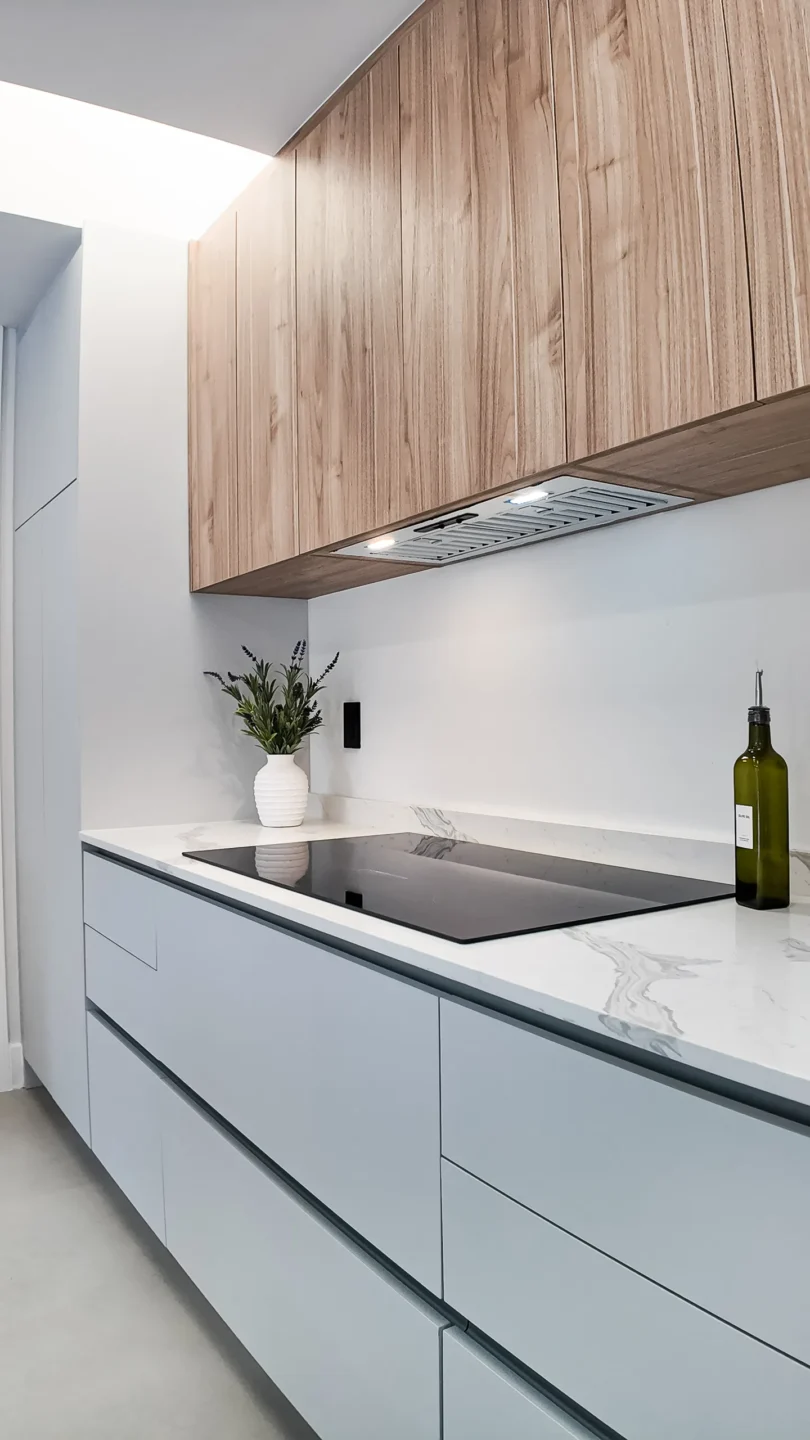
Side-by-side comparison
| Decision factor | Semi-custom | Fully custom |
|---|---|---|
| Dimensions | Standard sizes with selected modifications | Built to specified dimensions |
| Design flexibility | Moderate to extensive | Nearly unlimited |
| Material choices | Manufacturer's options | Project-specific options |
| Finish choices | Standard and upgraded finishes | Custom-matched finishes possible |
| Unusual architecture | May require fillers and panels | Can be built around the room |
| Quality | Depends on product line | Depends on shop and specification |
| Lead time | Usually shorter | Usually longer |
| Replacement parts | Often easier to order | May require reproduction |
| Price | Mid-range to premium | Premium to luxury |
| Best use | Standard and moderately complex kitchens | Unique or highly detailed projects |
Cabinet category does not determine quality
Custom is not a construction specification. A custom cabinet can still use thin panels, inexpensive hinges, weak drawer slides or an inadequate finish, while a semi-custom product may use well-engineered joinery, strong drawer systems and a tested factory finish. Evaluate the actual components instead of relying on category labels.
Cabinet quality checklist
Box construction
Ask for the material and thickness of sides, bottoms, shelves, backs, hanging rails, toe kicks and finished ends. Plywood, MDF and particleboard are distinct materials, and each can perform well when correctly specified and protected from water. Plywood is often chosen for strength and screw-holding; furniture-grade particleboard gives dimensional consistency in tested systems; MDF is common for painted doors because its smooth surface hides wood grain. The material name alone does not reveal density, veneer quality or edge protection.
Drawer construction
Review the drawer-box material, bottom-panel thickness, joint construction, slide manufacturer, weight rating, extension, soft-close operation and ease of removal. Dovetail joints are a recognized quality detail, but performance also depends on the bottom, slides and installation.
Hinges
Good hinges provide smooth movement, reliable soft-close, multiple adjustment points, a suitable opening angle, appropriate weight capacity and replacement-part availability. An expensive door on inadequate hinges will not stay aligned.
Finish and warranty
The finish protects the cabinet and determines how it ages against moisture, cooking oils, cleaners, sunlight, heat, scratching and yellowing. A factory finish can offer more consistency, and a skilled shop can match it when its preparation and curing are documented. Review what the warranty covers, boxes to finish to labor, and confirm the exclusions and claim procedures are reasonable.
Look for independent cabinet testing
When comparing semi-custom manufacturers, check whether the product carries the KCMA A161.1 Quality Certification Seal. The Kitchen Cabinet Manufacturers Association tests structure, shelf loading, wall-cabinet mounting, drawers, doors and finishes, cycling loaded doors and drawers thousands of times and exposing finishes to heat, humidity and common substances. A local custom shop may build excellent cabinetry without KCMA certification; in that case, request written material specifications, hardware information, finish-system details, references, shop drawings, samples and warranty terms so the comparison is evidence-based.
Custom vs semi-custom cabinet cost
Current national planning guides place installed semi-custom cabinetry at roughly $150 to $700 per linear foot and fully custom around $500 to $1,200 or more per linear foot, with high-end species, specialty finishes and complex details exceeding those ranges. These are not South Florida quotations; prices vary by manufacturer, material, kitchen size, installation and design complexity.
Why linear-foot pricing can be misleading
Two kitchens with the same wall length can have very different cabinet costs. A linear-foot allowance may not account for tall pantry cabinets, drawer bases, appliance panels, finished ends, decorative doors, refrigerator surrounds, crown molding, light rails, glass inserts, interior organizers, pull-out trash systems, corner mechanisms, island panels, delivery, installation or touch-up work. Compare itemized proposals based on the same approved layout. A heavily modified semi-custom order can approach custom pricing without the same dimensional freedom, so when many modifications are required, request a parallel custom quote.
Storage efficiency
Custom cabinets do not automatically provide better storage; storage improves when the design responds to your belongings and routine. Before choosing a cabinet type, inventory dinnerware, glassware, small appliances, pots and pans, baking trays, food containers, spices, pantry items, cleaning products, trash and recycling, and serving pieces.
Many semi-custom manufacturers offer roll-out shelves, deep drawers, tray dividers, spice pull-outs, corner organizers, lazy Susans, pull-out trash cabinets, mixer lifts, cutlery inserts and pantry accessories that solve most needs without custom fabrication. Custom storage adds value when a narrow leftover space can become functional, appliances are unusually large, accessibility requires different heights, an appliance garage needs exact clearances, or storage must integrate with a structural column. Do not add complicated accessories simply because they are available; every mechanism consumes interior space.
Fit and architectural integration
Semi-custom cabinetry typically uses fillers to close gaps between standard sizes and walls. Fillers are normal and often necessary for door and drawer clearance. Problems arise when excessive fillers reduce storage or unbalance the design. Custom cabinets can minimize gaps and align doors, drawers and panels with windows, ceiling beams, range hoods, wall openings, columns, appliance centers and adjoining furniture. This precision matters most in highly visible or unusually shaped kitchens.
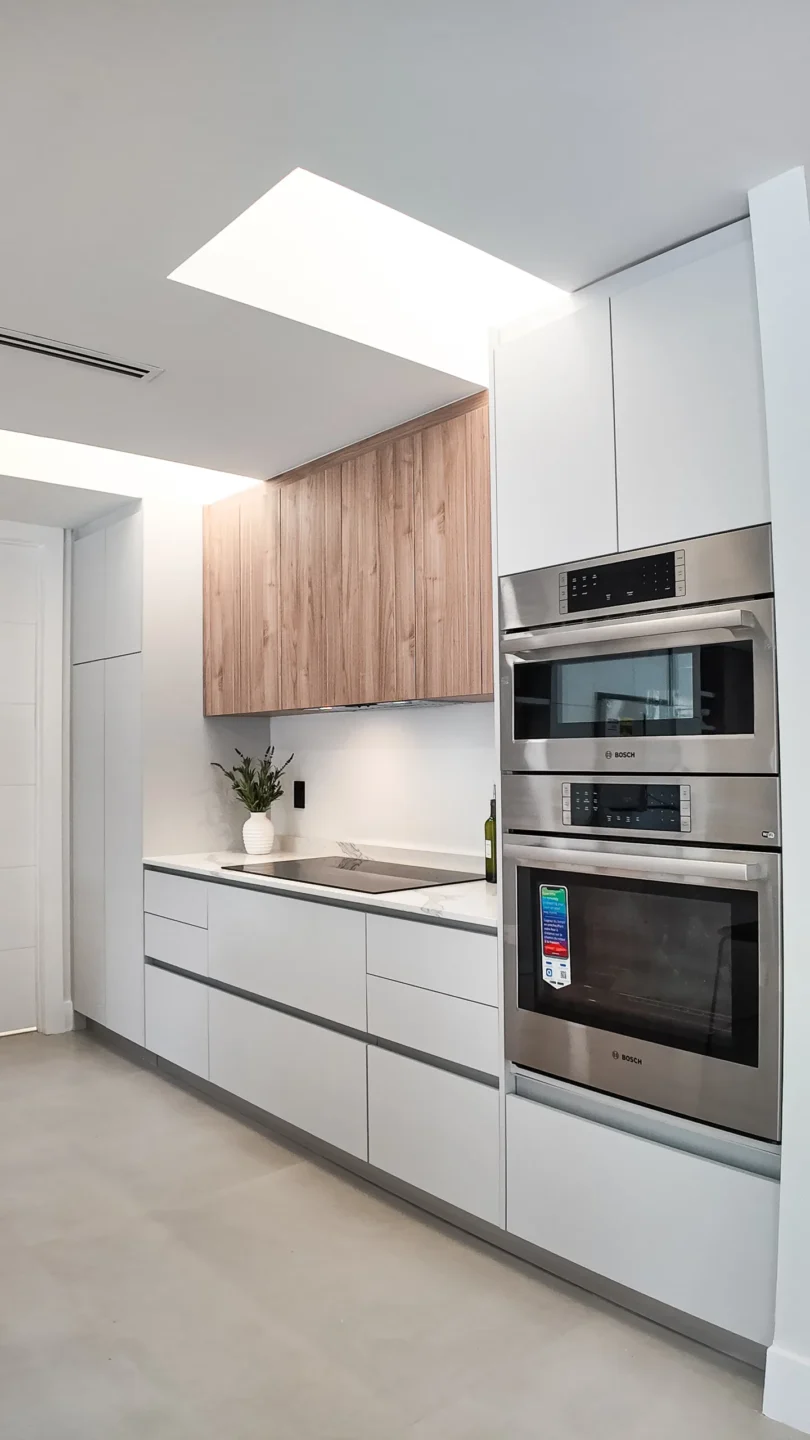
Framed vs frameless is not the same as custom vs semi-custom
Framed and frameless describe construction systems, not quality levels. Framed cabinets have a face frame on the front of the box, with doors and drawer fronts attaching to or overlaying that frame; they support traditional styling and partial-overlay, full-overlay or inset doors. Frameless cabinets have no face frame, so doors attach directly to the cabinet sides, giving cleaner contemporary lines, wider interior access and efficient drawer space. Both systems are available in semi-custom and fully custom, and either performs well when properly engineered and installed.
Inset vs overlay doors
Inset doors sit inside the cabinet frame and require precise alignment, so humidity-related wood movement and minor installation variations become more noticeable. Overlay doors cover some or most of the cabinet front and are more forgiving and easier to adjust. Inset cabinetry often carries a price premium, whether semi-custom or custom.
Lead time and project scheduling
Semi-custom production commonly takes about four to ten weeks, while fully custom cabinetry may need eight to sixteen weeks or longer, depending on the manufacturer, materials, finish, approvals and delivery location. Do not schedule demolition on an early estimate.
Complete the design
Finalize the layout and confirm appliance specifications.
Verify and approve
Confirm field measurements and approve the cabinet drawings.
Finalize and order
Lock materials and finishes, then place the order.
Track and inspect
Get a written production update and inspect delivered cabinets.
Then demolish
Begin demolition according to the construction schedule, once availability is confirmed.
South Florida cabinet considerations
Humidity and water
South Florida humidity is relevant, but cabinet failures more often come from direct water, plumbing leaks, poor ventilation or unprotected panel edges. Repair leaks immediately, use an under-sink tray, seal penetrations, maintain dishwasher ventilation, run air conditioning and a range hood, and keep exterior-rated cabinetry outdoors. No wood-based interior cabinet should be expected to survive repeated water saturation.
Painted doors, coastal air and condos
Solid-wood doors expand and contract, so painted joints may reveal fine lines, particularly on five-piece doors; stable MDF center panels can give a smoother painted appearance, though exposed MDF edges must be protected from water. Salt air can affect hinges, slides, pulls and fasteners, so review hardware finish and corrosion resistance for coastal or poorly conditioned spaces. For condominium projects, confirm delivery hours, freight-elevator reservations, insurance, staging space and board approval, and check that preassembled cabinets fit the entire delivery route. Regulated composite-wood components should meet EPA TSCA Title VI formaldehyde standards, so ask the supplier to confirm compliance, especially for imported products.
Installation quality can erase the difference
Premium cabinets perform poorly when installed incorrectly. Professional cabinet installation should address wall and floor irregularities, level and plumb, secure wall attachment, cabinet-to-cabinet alignment, door and drawer adjustment, appliance clearances, countertop support, island anchoring, finished fillers and panels, crown transitions and final touch-ups. Uneven South Florida concrete floors and imperfect walls may require careful scribing and leveling; custom sizing cannot compensate for careless installation.
A hybrid cabinet strategy
Some kitchens benefit from combining categories: semi-custom perimeter cabinets with a custom island, semi-custom boxes with custom decorative panels, custom pantry cabinetry with standard kitchen cabinets, or manufacturer cabinets with a locally fabricated range hood. A hybrid plan focuses custom spending where it has the most visual or functional impact. Confirm that colors, door proportions, finishes and reveals coordinate before ordering from different sources.
Decision guide
Choose semi-custom when
- The room works with available cabinet sizes
- Quality construction is available in the line
- Standard accessories meet storage needs
- You want predictable finishes and replacement parts
- The budget must remain balanced
- A shorter lead time is preferred
Choose custom when
- Every inch of storage matters
- Walls or ceilings are irregular
- Standard dimensions create unacceptable fillers
- The design requires unusual shapes
- You need a particular species or matched finish
- Cabinetry must align exactly with architecture
- The design cannot be achieved from a catalog
Common myths
Myth: custom cabinets are always higher quality
Custom describes design flexibility. Quality depends on materials, construction, hardware, finish and installation.
Myth: semi-custom cabinets are just stock cabinets
Semi-custom cabinets are usually built to order and may allow meaningful dimensional and design changes.
Myth: plywood automatically makes a cabinet premium
Plywood grade, thickness, veneer, joinery and finish all affect quality.
Myth: solid wood is best for every component
Stable engineered panels are often more appropriate for boxes, large panels and painted doors.
Myth: soft-close hardware proves a cabinet is high quality
Soft-close is one feature. Box construction, drawer performance, finish and installation also matter.
Frequently asked questions
Are custom cabinets better than semi-custom cabinets?
Custom cabinets provide greater design freedom, but they are not automatically better constructed. A high-quality semi-custom line may be the better value for a standard kitchen.
How much more do custom cabinets cost?
Custom cabinets commonly cost substantially more because of design, engineering, materials and small-batch production. Compare itemized proposals based on the same layout.
How long do custom cabinets take?
Fully custom cabinets may require eight to sixteen weeks or longer after final approval, and complex finishes can extend the schedule.
How long do semi-custom cabinets take?
Many semi-custom orders take about four to ten weeks, though manufacturer schedules and material availability vary.
Can semi-custom cabinets reach the ceiling?
Often yes. Available heights, stacked cabinets, moldings and fillers may create a ceiling-height installation depending on ceiling height and product options.
Are custom cabinets made from solid wood?
Not necessarily. Quality custom cabinets frequently combine plywood, MDF, veneers and solid wood according to each component's function.
Are plywood cabinets better for Florida?
Quality plywood is often a strong box option, but no interior wood product should be repeatedly exposed to water. Construction and edge protection also matter.
Are semi-custom cabinets suitable for a luxury kitchen?
Yes. Premium semi-custom lines can provide quality materials, sophisticated finishes and extensive accessories. Fully custom becomes necessary when the design exceeds the line.
Can custom and semi-custom cabinets be combined?
Yes, but door proportions, finishes, reveals and hardware must coordinate carefully.
When should countertops be measured?
Final countertop measurements normally occur after base cabinets are installed, secured, level and ready to support the countertop.
Plan your South Florida kitchen cabinetry
MIA Remodeling Contractors helps homeowners coordinate kitchen layouts, cabinet design, cabinetry, countertops and professional installation across South Florida. Our team can evaluate whether semi-custom cabinets can achieve your goals or whether fully custom cabinetry provides meaningful advantages.
Florida general-contractor license CGC1535875. Serving Miami-Dade, Broward and Palm Beach counties.